A Brush With Trauma While Horseback Riding in Chile’s Atacama Desert

Being thrown from a horse triggered my body’s fight-or-flight response, but what came next was truly surprising.
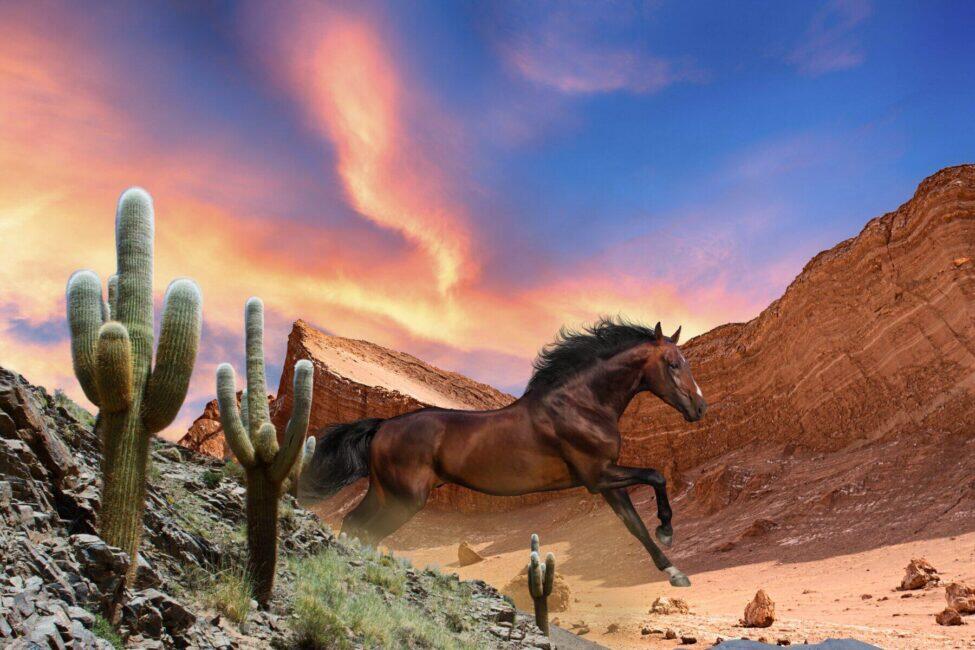
The moment felt as if someone had slowed down the seconds, letting them move past me frame-by-frame. The power of the horse thrummed between my thighs, his legs running at full speed, the crunch of his hooves slamming against the dirt-packed ground. Equal parts adrenaline and fear rose in my chest. But then, I noticed how unsteady I felt perched atop this great animal’s flank, like a sailboat bobbing atop a turbulent sea. The faster the horse ran, the more he began to shudder, as if he decided mid-gallop that he’d had just about enough of the anxious New Yorker clinging to his back.
I had met my horse, Compadre (Spanish for “buddy”), three hours prior as part of an excursion into the surrounding desert. The Atacama Desert sits between the Andes Mountains and the Pacific Ocean in northern Chile, and boasts a surprisingly diverse landscape that varies from mirror-like salt flats to bubbling geysers to lush valleys. The day’s horse ride was meant to show me the Mars-like terrain of the desert, transporting me into a world of time-weathered rock formations, rolling sand dunes, and ancient gorges.
Up until the last five minutes, the entire ride had proved lovely, memorable, and largely uneventful. Riding alongside my guides and another traveler, we had even tried galloping in the open expanse of soft, orange sand dunes. Everything about the previous gallop contrasted with this one. This time, the dirt ground was hardened and the area narrow, flanked by a small stream and bushes that hid barking street dogs on one side and low-slung houses on the other. Unlike the earlier gallop, which saw us running freely two hours away from the stables, the horses seemed eager to return to the food, water, and shade that their shelters promised. I couldn’t blame them.
Taking in the surroundings, trepidation rose in my chest as our guide encouraged us to nudge the horses forward and begin our run for a second time. Chalking my worries up to anxiety, I silenced my inner voice, gently urged Compadre forward with the tap of my heels into his side, and let him run wild.
I consider myself an animal lover; I am the type to volunteer to walk shelter dogs while vacationing in Mexico and to buy dog food for the strays roaming the streets of Bali, and while I’ve never considered myself an avid horseback rider (having only ridden a horse about three or four times in my adult life), when the opportunity to ride a horse in the Atacama Desert arose, it felt foolish to say no.
When I first met Compadre, I made a point of introducing myself the way I would to a dog. I extended my hand out low, letting him muzzle my flesh tentatively, introducing him to my scent before I turned to my guide to make sure Compadre (and the other horses) were well hydrated in the desert heat. I then brushed the hair from his eyes, pairing the action with soft, coo-like tones, in hopes that Compadre would feel at ease. Hell, I even thanked Compadre for the ride in advance. Throughout our ride together, I had hardly wanted to pull on Compadre’s leather reins, instead letting him enjoy a leisurely trot, but as I watched in horror as my horse tried to buck me off, I realized that my Compadre had become my foe.
As Compadre ran, I pulled on his reins, hoping a sharp tug might stop the dash, but instead, he jerked his head and lifted his front legs—all without breaking stride—making it clear that he was as done with this ride as I was with horseback riding. I loosened the harness, realizing with that split-second clarity that comes in dire situations that if I tried my luck again, I might be thrown backward. As I called out for help, I desperately clung to the saddle, my body slipping with each bump and shake. I knew I had mere seconds before I was tossed. One last image burned into my brain: my fingers white-knuckled around the edges of the brown leather saddle, the horse running as its muscles rippled across its back, the ground beneath us a blur, and my body suddenly slipping off, off, off until I felt nothing but air.
My right thigh hit the dirt first. My thighs, so often the undeserving object of my scrutiny, broke my fall, absorbing the full impact. My arm hit next, followed by my head (thankfully ensconced in a helmet). As my body landed with a sickening thud, my eyes instinctively screwed tight, erupting into a mini firework display behind my closed lids. As the world stilled and I realized I hadn’t died, the situation dawned on me in a string of broken thoughts: I fell…I fell off a horse…I fell off a galloping horse here in the Atacama Desert. I’m alive. But am I okay?
As the daughter of a doctor, I’m somewhat of a hypochondriac. WebMD is my mortal enemy, as is the barrage of news articles warning of yet another cancer-causing chemical in our everyday lives (don’t get me started on PFAs and my great non-stick pan purge of 2022). My childhood tales weren’t the typical fables of misled characters overcoming obstacles to find redemption. No, my cautionary tales were emergency room horror stories. If I wrinkled my nose at the prospect of wearing bulky kneepads while rollerblading, my dad would have a story about someone my age (always somehow my age) who had come to the ER with their kneecaps popping out of their skin as a result of not wearing protective gear. If I rolled my eyes at the “embarrassment” of having to wear a bike helmet in public, my dad would share stories of paralyzed patients who would be up and walking had it not been for the very helmet I was eschewing.
On the ground, I sat up slowly, assessing what had just happened. Thoughts of my dad’s stories and the late actor Christopher Reeve’s horse accident (a documentary that had been playing on my flight down to Santiago) flooded my mind. The first words I spoke were: “Am I paralyzed?” I stood up slowly, gently moving my neck from side to side, turning my head left and then right, shaking out my arms, fanning my fingers, all with the irrational fear that if I stopped moving, my body might somehow seize up and never move again.
Miraculously, I was okay, barring a few bruises and scratches, and yet I could hardly believe it. I found myself trying my best to uphold social graces as I walked alongside Compadre and my fellow traveler to the stables. An embarrassed laugh, a chuckle that I was fine, and soon I was making my way to the comfort and solitude of my hotel room. I felt something in me snap as my room door closed. Some part of me had struggled to free myself of the fear, and once alone, I completely fell apart.
When Panic Becomes Trauma
Hours after my fall, I found myself feeling more fragile than I have in recent memory. Tears fell easily. My body shook and tensed. I was irrationally afraid; half expecting Compadre might emerge from my shower, ready to throw me one more time. I paced the room, called family and friends, and worried that my trembling hands would never steady. I was a jittery, anxious mess standing at odds with the calm and quiet of the Atacama Desert.
Physically, I was okay, but emotionally, I was wrecked, suspended somewhere between relief and disbelief. I tried to reassure myself that I was not going to experience sudden paralysis or brain injury hours after my fall and that—logically speaking—if I were to have suffered either of those life-altering injuries, I wouldn’t be walking or talking, let alone writing my feelings down. But, of course, emotions—much like Compadre—are hard to harness once they run free.
“Sometimes, our body and our mind have a really strong reaction to a situation or experience [like falling off a horse] that isn’t due to a past trauma,” explains Ruthie Arbit, Psychotherapist and Director of Arbit Counseling, a group therapy practice. “It can be because that experience, taste, sound, or object stirred up a primordial, almost instinctive, deep fear you have.”
Dr. Arbit speculates that my sense of safety and stability were compromised the moment Compadre threw me, leading to a strong physical and mental reaction in the hours that followed; a reaction she believes might have been akin to a panic attack.
“Any scary experience has the potential to be experienced as a traumatic event, but doesn’t have to be. Trauma is a lot about our perception of the event, sometimes more so than the event itself,” she adds. “Many of us in the therapy world reference Dr. Bessel Van Der Kolk’s idea that ‘The Body Keeps the Score,’ meaning your body physically reacts to memories of your trauma even when your brain doesn’t or cannot.”
There are many different types of trauma. There’s the sort of trauma that is life-defining, the kind that creates a before and after in one’s life. There’s the sort of trauma that comes from secondary exposure to something awful that is hard to unsee and therefore harder to get over. There’s the type of trauma that is endured over long periods of time, like a survivor learning to move forward after years of abuse; and then there’s the sort of trauma that catches you off guard, an instant that leaves an indelible mark, leaving a person skittish like a dog during 4th of July fireworks. In my case, this could mean the next time I get on a horse (which is unlikely to happen again in my lifetime), I could experience panic—and therefore trauma—related to the memories of being thrown from Compadre.
Fight or Flight
Growing up, my dad would tell me the best way to squash fears is to arm oneself with knowledge. To examine my reaction medically is to look at the body’s fight-or-flight response. Falling off Compadre triggered my sympathetic nervous system, launching my fight-or-flight response, in which my body released adrenaline and norepinephrine, increasing my heart rate, blood pressure, and alertness. It was this response that gave me the sensation of time slowing down, second by second, prompting the shocking clarity amidst the chaos that I had to stop pulling Compadre’s harness, lest he bucked and threw me backward.
During fight or flight, your body tenses, you become hyper-aware, and—according to a study from Harvard Health Publishing—your body reacts in a way that optimizes your chances of survival. Despite lacking any horseback riding experience, I knew in one crystalline moment that landing on my spine would be a far greater risk than falling to my side, and so I let the harness go—I have my fight-or-flight response to thank for that.
In the hours following my fall, my body entered what is known as a parasympathetic phase or crash (AKA shock). As the adrenaline that floods your system begins to dissipate, it’s normal to feel shaky, exhausted, and yes, even cry. In some instances, the release of adrenaline can cause nausea and chills. Your body is recovering from trauma, and psychologically, you are receding from the complete shock and alarm, explains Dr. Bessel van der Kolk. Your sense of safety has been disrupted, and it takes time to regain a sense of security and calm.
As the hours passed, eventually so did my emotions, like a big wave pulling back from the shore. I found myself steady yet vulnerable, as if nursing a fresh wound tender to the touch. Armed with the knowledge of what happened and why, I was finally able to quell my fears.
The next morning, I opened my eyes to my empty room, the desert sun pouring in through the floor-to-ceiling windows, illuminating the warm and welcoming space. I awoke feeling lighter, buoyed even, by the promise of a new day—and the growing realization that yesterday could be nothing more than a story, not a life-defining event. I was awash in gratitude for my body, my mind, and yes, even my thighs.
link